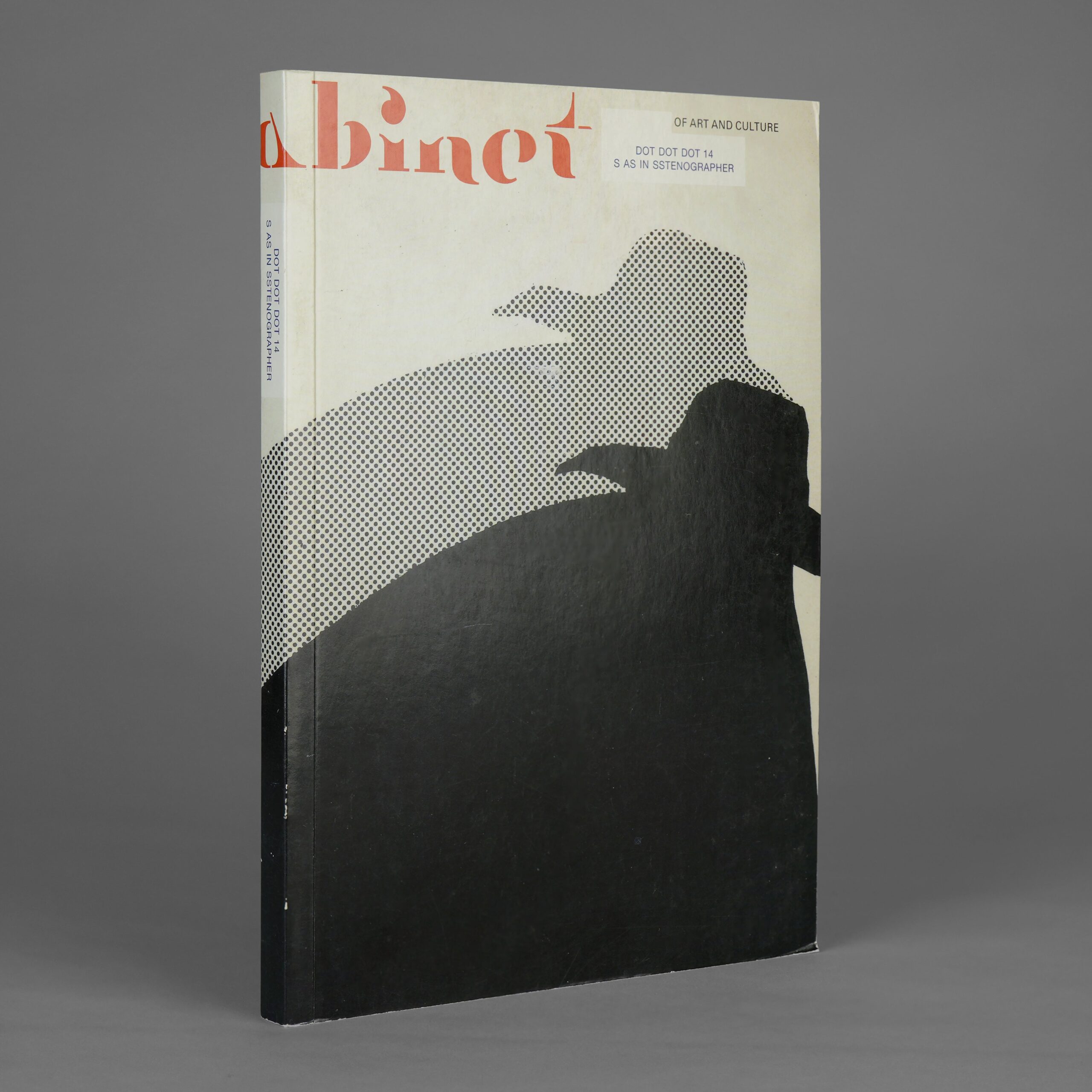
Dot Dot Dot 14
S AS IN SSTENOGRAPHER Issue 14 of the iconic design journal whose very name promised more to come... Dot Dot Dot was a critically minded, independently published journal of graphic design and visual culture, active from 2000 to 2010. The journal brought together a multidisciplinary mix of contributors—from designers and artists to writers and theorists—to cover art, music, language, film and literature. Issue No. 14 offers a wide variety of inventive critical writing on all aspects of culture. From the back cover: In 1988–89, Gilles Deleuze consented to take part in a series of interviews conducted by Claire Parnet and filmed by Pierre-André Boutang on the condition that they were to be broadcast only after his death. The conversation hung on a series of trigger-words, proceeding in alphabetical order from Animal through Neurology to Zigzag, a conceit which resulted in l'Abécédaire —an “ABC Primer” of Deleuze’s ideas. Five years on, his condition was duly broken and the eight hours of footage were broadcast on the Arte channel in 1994–95, a year before Deleuze's death. It has since been released in France on VHS in 2001 and DVD in 2004. In 2006 a friend and teacher visiting New York handed me a few flight-worn sheets of “P as in Professor” in advance of some discussion on the future of art school; about a year later I came across the video of “B as in Boisson” being screened one Sunday evening in a bar in Los Angeles; finally, I found a transcription of the interviews on the website of Charles J. Stivale, a professor in Romance Languages & Literatures at Wayne State University in Detroit. Stivale’s transcription reminded me of why I’d been so taken with the interviews in the first place: not entirely because of what Deleuze was saying—though that was certainly captivating enough—but at least as equally because of the odd nature of the transcription. Stivale had, for obvious reasons, compressed the eight hours into a readable summary of Deleuze’s “pure” thought (i.e., unadulterated by the usual transference to the written word), and in so doing had—I like to think unconsciously—embedded slight scenario details, such as Deleuze and Parnet’s movements, facial expressions, and general attitudes. These inclusions are nothing particularly special, nor even that apparent, but on first reading they coalesced into a form of transcription I couldn’t recall reading before—a kind of curiously conscious third person, once or twice removed. It brought to mind the detached, mechanical witness figure of a stenographer, seen but not heard, automaton with a human heart. The Stenographer slowly became this issue’s abstract godfather, and its corollary Deleuze Primer—with its easygoing slalom around pretension and cynicism refracted through the lens of Stivale’s stenography—seemed to constitute a readymade DDD14 . We decided the whole issue should accordingly consist only of the transcription in its entirety. That was the big idea, at least, before the stenographer in question politely declined the offer, quite reasonably content with its drifting presence on the internet. The refusal, however, seemed to open up another opportunity: to see what would happen if we zoomed out one more editorial level, taking on the role of the fourth person, two or three times removed—the Stenographer’s Stenographer—to further excerpt and summarise Deleuze’s glossary of casual wisdom. Both this process and the wide-ranging themes of the interview then intersect with the rest of DDD14 , which grew around it in ways which surely demonstrate Deleuze’s ideas at the same time as recounting them... A short description of the interview “set”: Deleuze is seated in front of a fireplace in which there is a mirror, and opposite sits Parnet. The camera is located behind Parnet’s left shoulder so that, depending on the camera focus, she is partially visible from behind and, with a wider focus, visible in the mirror as well. The production quality is quite good, and in the three-cassette collection now commercially available, Boutang has chosen not to remove by editing the jumps between reel changes; rather, Deleuze cooperates quite patiently with the small breaks in the movement of the production. Prior to starting to discuss the first “letter” of his ABC primer, Deleuze mentions the premises of this series of interviews: that Parnet and Boutang have selected the ABC primer format and had indicated to Deleuze what the themes would be, but not specific questions. He states that answering questions without having thought about them beforehand is something inconceivable for him, but that he takes solace in the precondition that the tapes would be used only after his death. So, this somehow makes him feel great relief, as if he were a sheet of paper, even some state of pure spirit. But he also wonders about the value of all this since everyone knows that a pure spirit is not someone that gives very profound or intelligent answers to questions posed. Printed in 2007, this vintage issue is from the original run of Dot Dot Dot . While copies are new and unread, they may show slight shelf wear, minor corner bumps, or signs of age from long-term storage. All pieces designed by editors/authors, with the exception of two noted works. Edited by Stuart Bailey, with co-editor David Reinfurt Published by Dexter Sinister, 2007 Softcover, 134 pages, color and b&w, 6.5 × 9.25 inches ISBN: 978-9-07-762008-3
Publisher
Dot Dot Dot
Publication year
2007
ISBN-13
9789077620083
Pages
160
Language
English
Subjects
- Have:1
- Want:—
- Avg Rating:—
- Ratings:—
Who has this book
1 Connection
- Go to @2mb@2mb
























Community Notes