This website uses cookies.
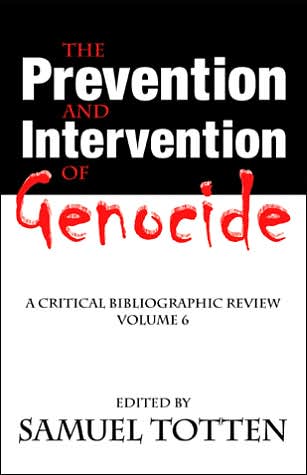
The Prevention and Intervention of Genocide cover

The Prevention and Intervention of Genocide

by

Over the last twenty years the world has witnessed four major genocides. There was the genocide in Iraq (1988), in Rwanda (1994), in Srebrenica (1995), and in Darfur (2003 and continuing). Most observers agree there is an urgent need to assess the international community's efforts to prevent genocide and to intervene (once a genocide is under way) in an effective and timely manner. This volume, the latest in a widely respected series on the subject of genocide, provides an overview of a host of issues germane to this task.The book begins with a cogent discussion of the issues of prevention and intervention during the Cold War years. The second chapter discusses the abject failures and moderate (though, in some cases, highly controversial) successes at prevention and intervention carried out in the 1990s and early 2000s. Further chapters examine latest efforts to develop an effective genocide early warning system and examine the complexity of and barriers to prevention. The pros and cons of sanctions and the problems of enforcement and evaluation their effectiveness are then discussed. Conflicts between state sovereignty and the protection of threatened populations are examined both in historical context and by incorporating the latest thinking.Later chapters treat the issue of intervention; why and how it has met with only limited success. Concentrating on Rwanda and Srebrenica, chapter 8 discusses various peace operations that were abject failures and those that were moderately successful. The concept of an anti-genocide regime is examined in terms of progress in developing such a regime as well as what the international community must do in order to implement it. Chapters discuss key issues related to post-genocidal periods, those that need to be addressed in order to establish stability in a wounded land and populace as well as to prevent future genocides. The final chapter asks whether bringing perpetrators to justice has any impact in breaking impunity, ensuring deterrence, and bringing about reconciliation.The contributors to the volume are all noted scholars, some of whom specialize in the study of genocide, and others who specialize in such areas as early warning, peacekeeping, and sanctions.
Publisher
Transaction Publishers
Publication year
2002
ISBN-13
9780765803849
ISBN-10
1016045387
Pages
320
Language
English
Subjects
Genocide StudiesHuman RightsInternational LawConflict ResolutionPolitical ScienceEthnic ConflictPeace Studies

  • Have:1
  • Want:
  • Avg Rating:
  • Ratings:

Who has this book

1 Connection

Recommendations

The Scots
The Scots
by Murray MacKinnon
The Irish: How They Shaped the World
by J.P. Mallory
Eureka!
Eureka!
by Accident
War and Reason: Domestic and International Imperatives
by Bruce Bueno de Mesquita
The International Law of Human Rights and States of Exception
by Anna-Lena Svensson-McCarthy
Palestine Speaks: Narratives of Life Under Occupation
by Mateo Hoke & Cate Malek
The Best of Enemies: Memoirs of Bassam Abu-Sharif and Uzi Mahnaimi
by Bassam Abu-Sharif and Uzi Mahnaimi
When Victims Become Killers: Colonialism, Nativism, and the Genocide in Rwanda
by Mahmood Mamdani
Nothing to Envy: Ordinary Lives in North Korea
by Barbara Demick
Democracy in Plural Societies
by Arend Lijphart
Ending Wars Well
Ending Wars Well
by Eric D. Patterson
The Gulag Archipelago, 1918-1956
by Aleksandr Isaevich Solzhenitsyn
The Gulag Archipelago, Volume 3
by Aleksandr I. Solzhenitsyn
The Gulag Archipelago
by Aleksandr I. Solzhenitsyn
Preventing Palestine: A Political History from Camp David to Oslo
by Seth Anziska
Obeying Orders: Atrocity, Military Discipline and the Law of War
by Mark J. Osiel
How to Do Things with International Law
by Ian Hurd
The Guest Worker Question in Postwar Germany
by Rita Chin
Some People Need Killing
by Patricia Evangelista
Red Zone: China’s Challenge and Australia’s Future
by Peter Hartcher
Plots and Prayers
Plots and Prayers
by Niki Savva
Homecoming: The Path to Prosperity in a Post-Global World
by Rana Foroohar
Political Parties: A Sociological Study of the Oligarchical Tendencies of Modern Democracy
by Robert Michels
Negative Publicity: Artefacts of Extraordinary Rendition
by Edmund Clark and Crofton Black
State of Emergency // How We Win in the Country We Built
by of State of Emergency
The Colors We Share
The Colors We Share
by Angélica Dass
Building Security in the New States of Eurasia: Subregional Cooperation in the Former Soviet Space
by EastWest Institute (New York
Control Order House
Control Order House
by Edmund Clark
The Mastermind
The Mastermind
by Evan Ratliff
Juvenile in Justice
Juvenile in Justice
by Richard Ross

Market

Community Notes